Chapter 07 — Scale and consequence
Business &
Global Impact
One company’s significance is easier to judge against the industry it belongs to. This page sets Sun Pharma beside the Indian pharmaceutical sector, and that sector beside the world’s supply of medicines.
01 — The sector
India as a supplier of medicines to the world
India is the third-largest pharmaceutical producer in the world by volume and the fourteenth by value — a gap that describes the industry precisely. It makes an enormous quantity of medicine, at low unit prices, for a very large number of countries.
India’s share of selected global supply categories
Source: India Brand Equity Foundation, Indian pharmaceutical industry report. Figures are the most recent published at the time of writing.
02 — Position
Sun Pharma inside that picture
Within an industry of roughly three thousand Indian companies, Sun Pharma holds the largest single share of the domestic market — 8.4 per cent at the close of the 2026 financial year, up from 8.1 per cent a year earlier, the company’s largest share gain since the Ranbaxy merger.
It is also among the most internationally weighted. Roughly two-thirds of revenue is earned outside India, from 41 manufacturing sites supplying more than a hundred countries. That combination — domestic leadership and majority foreign revenue — is what distinguishes it from most of the sector.
Where the company operates
India
The largest pharmaceutical company in the country by domestic sales, with an 8.4 per cent market share. India formulation sales in the March 2026 quarter were ₹4,836 crore, an increase of 14.8 per cent. The domestic business spans branded generics across neuro-psychiatry, cardiology, diabetology, gastroenterology, dermatology and ophthalmology, and consumer health products.
United States
Entered in 1997 through Caraco and expanded through Taro in 2010 and Ranbaxy in 2015. Formulation sales of US$459 million in the March 2026 quarter. The company holds 552 approved abbreviated new drug applications and 57 approved new drug applications, and ranks second in generic dermatology by prescription volume. Its United States innovative-medicines business passed one billion dollars during FY2026.
Emerging markets
A presence built across roughly eighty countries, including through the acquisition of Biosintez in Russia in 2016 and the Uractiv portfolio from Fiterman Pharma in Romania in 2022. Branded generics remain the dominant model in these markets, where prescriber relationships and brand recognition matter as much as price.
Japan and Greater China
Entered Japan through the acquisition of fourteen prescription brands from Novartis in 2016 and Pola Pharma in 2019; ILUMYA was launched in Japan in 2020. The company entered the Greater China market in 2019. Both are markets where regulatory standards are high and entry without a local platform is slow.
Western Europe, Australia and Africa
A smaller but established presence, extended by acquisitions including GlaxoSmithKline’s opiates business in Australia in 2015. Manufacturing sites in Europe, Africa and Australia support both regional supply and the wider network.
Sources: Sun Pharmaceutical Industries FY2026 results and corporate profile; company milestone disclosures.
03 — Consequence
What large-scale generic manufacturing actually does
The economic argument for the Indian pharmaceutical industry is usually made in export figures. The health argument is more consequential and less often stated precisely.
Generic medicines are the mechanism by which a treatment discovered in one country and priced for wealthy health systems eventually becomes affordable everywhere else. When a patent expires, the price of a molecule falls only if there are manufacturers capable of producing it to regulatory standard at scale. India supplies about a fifth of the world’s generic medicines by volume and hosts the largest number of US FDA-approved plants outside the United States; that capability is the reason the fall in price happens at all in much of the world.
Sun Pharma’s contribution to this is specific rather than general. Its concentration in chronic-therapy areas — psychiatry, cardiology, diabetology, dermatology, ophthalmology — means that its products are largely taken over long periods by people managing continuing conditions. Its technical position in complex dosage forms, including liposomal drugs, inhalers, lyophilised injections and controlled-release formulations, addresses precisely the products that are hardest for generic manufacturers to replicate and therefore slowest to fall in price.
The specialty portfolio built since 2014 does something different again. ILUMYA, CEQUA, WINLEVI, LEQSELVI and UNLOXCYT are patented medicines in dermatology, ophthalmology and oncology — the company operating as an originator rather than a follower, in therapeutic areas where treatment options remain limited.
Employment and economic contribution
Sun Pharma employs more than 43,000 people worldwide, including over 2,900 in research and development. The Indian pharmaceutical sector as a whole contributes approximately 1.72 per cent of national GDP and exported roughly US$31 billion of pharmaceutical products in FY2026, reaching around 200 countries.
A necessary qualification
Scale in pharmaceutical manufacturing carries a permanent obligation. A company supplying more than a hundred regulated markets is inspected continuously, and enforcement action is a recurring feature of the industry rather than an exception. Sun Pharma’s Halol facility has been under a United States import alert since December 2022 and remained classified Official Action Indicated after a June 2025 inspection, as the company disclosed in September 2025. Any honest account of impact includes the compliance record alongside the supply figures.
04 — Standing
A company that is also an institution
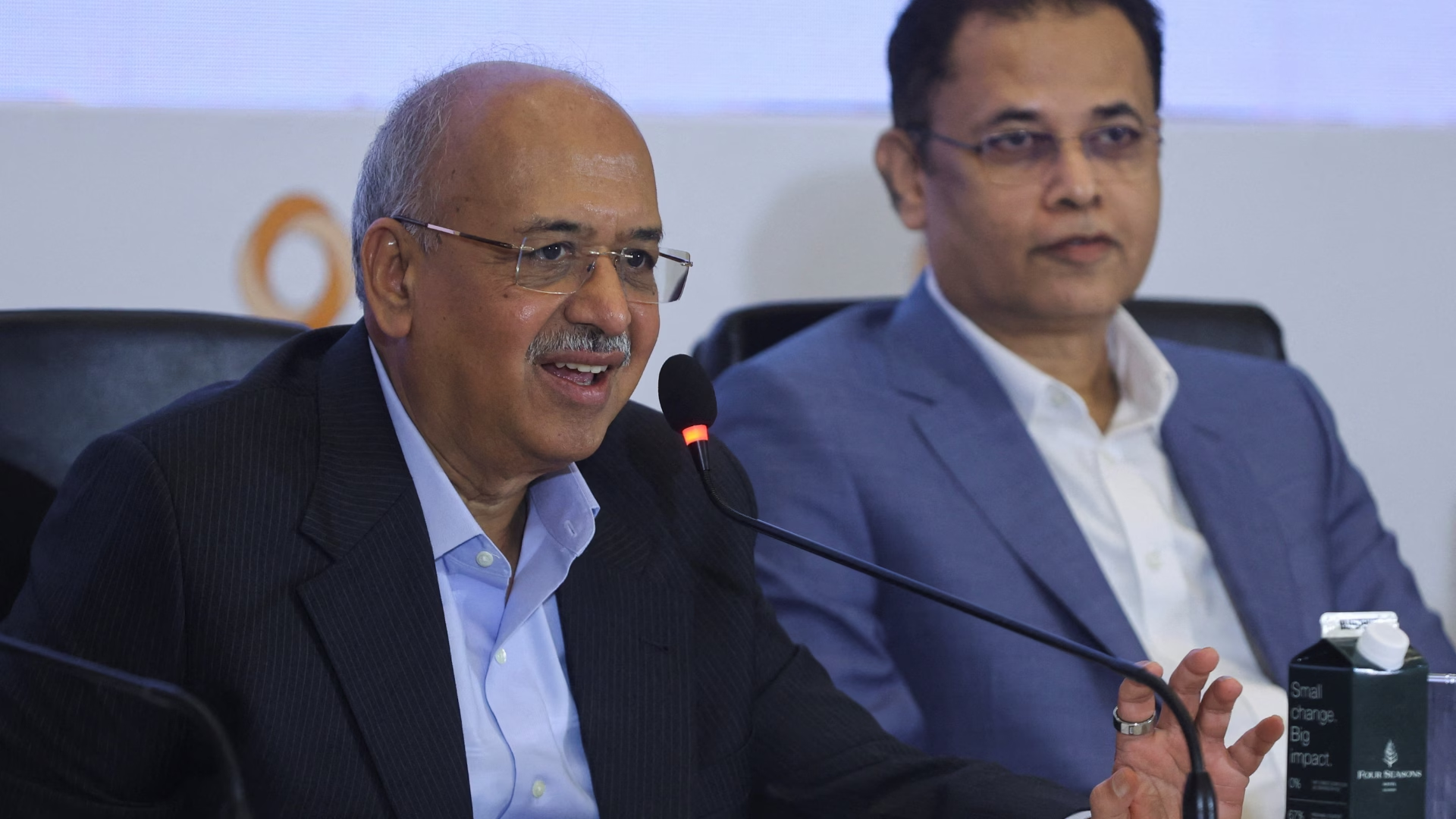
Sun Pharma is a constituent of both the SENSEX and the NIFTY 50, which places it among the companies whose performance shapes the Indian equity market as a whole. Its founder sits on the central board of the Reserve Bank of India and has chaired the Board of Governors of IIT Bombay.
That combination — commercial scale, index weight and institutional participation — is what distinguishes an enterprise from a large business. Decisions taken inside the company have consequences for Indian savers, for the country’s export position and for patients in markets that have no domestic manufacturing capability of their own.